Restoring Confidence. Revealing You.
Scalp Micropigmentation
A customized, non-surgical approach designed to replicate the appearance of natural hair follicles, enhance visible density, and create a realistic, balanced result.
Hair loss can change more than your hairstyle. A receding hairline, thinning crown, visible scalp, or hair-loss pattern can significantly change the way you see yourself.
Scalp micropigmentation (SMP) is a specialized form of cosmetic tattooing that uses carefully placed follicle-like impressions to create the appearance of natural hair at the scalp.
At The Skin Restoration Room, every SMP treatment is individually designed around your existing hair, pattern of hair loss, scalp characteristics, skin tone, facial structure, hairstyle, age, and personal goals.
Whether the objective is a natural shaved-head appearance, greater visual density through thinning hair, hairline refinement, or camouflage of an appropriate scalp scar, the goal is the same: a subtle result designed specifically for you.
Scalp Micropigmentation
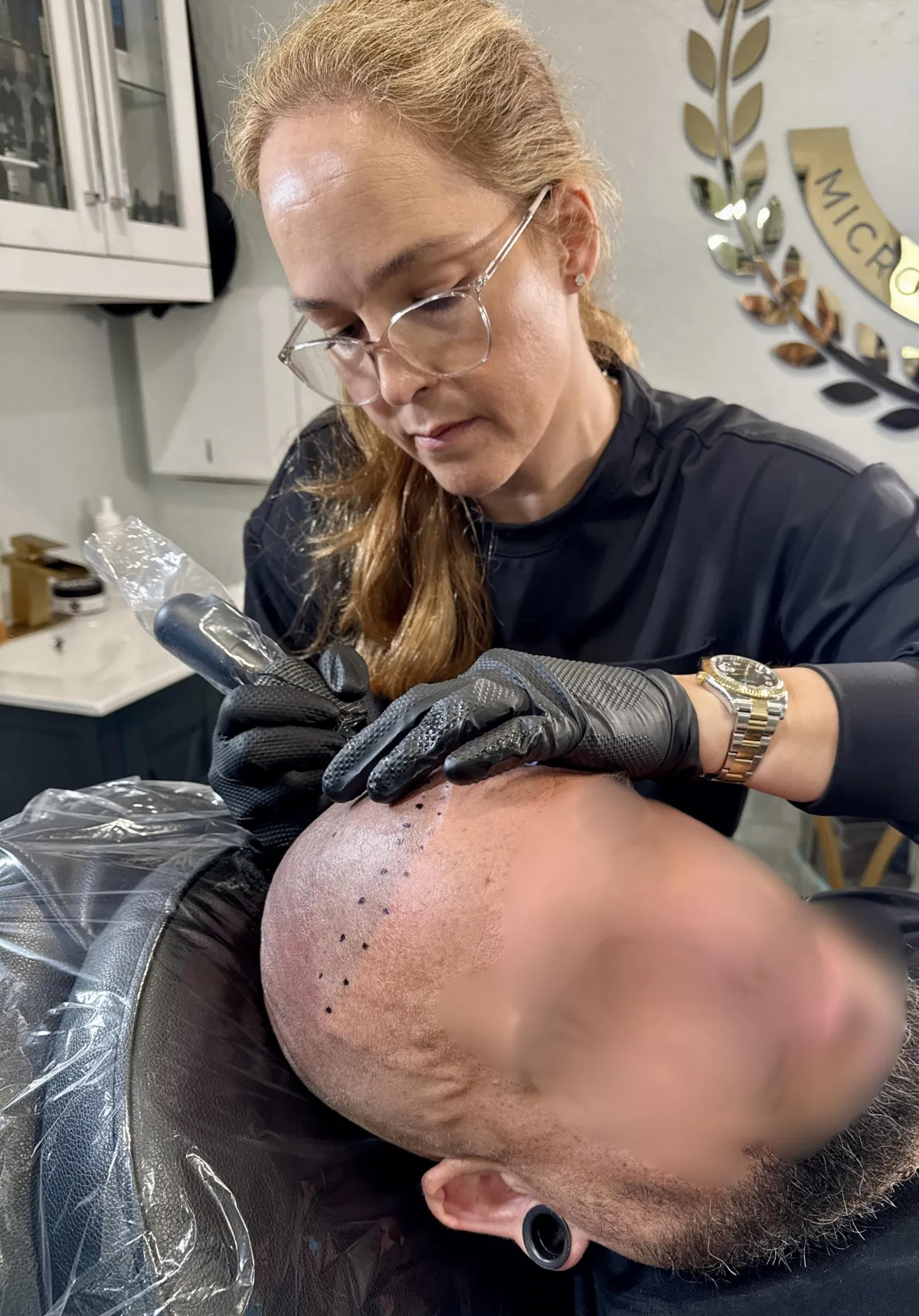
Scalp micropigmentation uses specialized equipment, pigments, and techniques to create thousands of carefully positioned impressions that replicate the visual appearance of natural hair follicles.
Treatment is customized according to the existing hair and the result we are trying to create.
WHAT SMP MAY ADDRESS
✦ Receding or changing hairlines
✦ Male pattern hair loss
✦ Female pattern hair loss
✦ Diffuse thinning
✦ Visible scalp through existing hair
✦ Crown thinning
✦ Partial or extensive hair loss
✦ FUT and FUE hair-transplant scars when appropriate
✦ Other mature, stable scalp scars when appropriate
✦ Selected stable areas of alopecia when appropriate
SMP does not grow hair. Instead, it uses visual density, follicle replication, and strategic design to reduce the contrast between the scalp and existing hair or create the appearance of a closely shaved head.
WHAT TYPE OF SMP IS RIGHT FOR ME?
SMP is not a one-size-fits-all procedure. Your treatment strategy depends on your existing hair, degree and pattern of hair loss, hairstyle, scalp visibility, skin tone, facial structure, age, and desired result.
SHAVED-HEAD EFFECT
For clients with significant hair loss or who prefer a closely shaved hairstyle, SMP can create the visual appearance of follicles across the scalp and establish or restore the appearance of a natural hairline.
DENSITY EFFECT
For clients who retain existing hair but experience thinning, carefully positioned impressions may reduce the visible contrast between the scalp and hair, creating the appearance of greater density.
HAIRLINE RESTORATION & REFINEMENT
SMP can visually redefine a receding, irregular, or diminished hairline. The design is individualized to complement facial proportions, age, existing hair, and personal preference.
SCALP SCAR CAMOUFLAGE
Appropriate mature scars—including some FUT and FUE hair-transplant scars—may be visually softened by integrating follicle impressions within and around the scar.
Your consultation determines which approach, or combination of approaches, is appropriate for you.
YOUR HAIRLINE SHOULD LOOK LIKE YOUR HAIRLINE
A successful SMP hairline should complement the individual—not look stamped on.
During the design process, we consider facial structure, forehead proportions, existing hair, natural growth patterns, degree of hair loss, age, hairstyle, and personal preference.
✦
Hairlines may be softer and more diffused, naturally irregular, more defined, or somewhere in between depending on the individual.
✦
Before treatment begins, the proposed hairline is mapped and reviewed with you. Adjustments can be made until the design feels appropriate.
✦
Our philosophy is conservative: a natural, believable hairline that ages well is more important than creating the lowest or sharpest hairline possible.
Am I a Candidate For Scalp Micropigmentation?
Scalp micropigmentation may be appropriate for a wide range of hair-loss patterns, but candidacy and treatment design are individualized.
During your consultation, we evaluate your existing hair, pattern and progression of hair loss, scalp condition, skin characteristics, previous hair restoration procedures, scars when present, hairstyle, treatment goals, and expectations.
SMP may be considered for individuals experiencing:
✦ Receding hairlines
✦ Pattern hair loss
✦ Diffuse thinning
✦ Crown thinning
✦ Visible scalp through existing hair
✦ Extensive hair loss with a closely shaved hairstyle
✦ Appropriate hair-transplant or other scalp scars
✦ Selected stable alopecia-related areas when appropriate
Active scalp irritation, infection, incompletely healed tissue, or certain unstable scalp or hair-loss conditions may require treatment or additional evaluation before SMP is considered.
When the cause or stability of hair loss is uncertain, medical evaluation or clearance may be recommended before treatment.
What to Expect?
CONSULTATION & DESIGN
We begin by evaluating your hair-loss pattern, existing hair, scalp condition, skin tone, facial structure, previous procedures or scars, hairstyle, and goals. For hairline work, the proposed design is mapped and reviewed with you before treatment begins. Pigment tone, follicle impression size, density, and placement are customized to create a result that complements your existing hair and features.
TREATMENT
During treatment, specialized pigment is deposited as carefully placed follicle-like impressions throughout the planned areas of the scalp. Rather than attempting to create the final density in a single session, SMP is typically developed progressively. This allows the impressions, density, and tonal balance to be refined as the treatment progresses.
HEALING
Immediately after treatment, the impressions may appear darker, sharper, or more prominent than the final healed result. Mild redness or sensitivity may also occur. As the scalp heals, the pigment typically softens and settles into a more natural appearance. The healed result—not the appearance immediately after treatment—is used to guide subsequent sessions.
FOLLOW-UP
At each subsequent session, we evaluate healing, pigment retention, density, hairline appearance, and overall integration with your existing hair and scalp. Additional impressions can then be strategically added or refined to develop the final result.
Why SMP Is Built In Layers?
Natural hair follicles do not appear as a single flat field of identical dots—and successful SMP should not either.
Building the result gradually allows us to evaluate how your skin heals and retains pigment before increasing density or making additional refinements.
Multiple sessions also allow subtle variation in placement and density, helping create a more natural visual effect.
Depending on the treatment plan, many SMP procedures are completed over approximately 2–4 sessions, although individual needs vary.
The objective is controlled progression. It is much easier to thoughtfully build additional density than to correct a result that was made too dark, too dense, or too aggressive in the first session.
What SMP Can - and Cannot - Do
Scalp micropigmentation can create the visual appearance of hair follicles, reduce contrast between the scalp and existing hair, visually redefine a hairline, and help camouflage appropriate scalp scars.
SMP does not grow hair, stop hair loss, increase the number of hair follicles, or medically treat the underlying cause of hair loss.
For clients with existing longer hair, SMP creates the appearance of greater density by reducing visible scalp contrast—it does not physically make the hair thicker.
For clients with extensive hair loss, SMP can create a realistic closely shaved appearance, but the tattooed follicles remain flat and do not produce actual hair.
Hair loss may also continue after SMP. Future progression can require modification or expansion of the treatment area.
Our goal is a natural-looking visual result based on your current hair, anticipated progression, facial structure, lifestyle, and long-term treatment goals.
Frequently Asked Questions
Does SMP grow hair?
No. Scalp micropigmentation does not stimulate hair growth or create new follicles. It is a cosmetic tattoo technique that replicates the visual appearance of hair follicles and can reduce the contrast between the scalp and existing hair.
Do I have to shave my head for SMP?
Not necessarily. The appropriate hairstyle depends on the type and extent of hair loss and the treatment goal.
Clients receiving density-focused SMP may retain their existing hair. Clients with extensive hair loss who are creating a full shaved-head effect generally achieve the most cohesive appearance when the remaining natural hair is kept closely cropped.
Your hairstyle and treatment strategy are discussed during consultation.
Will SMP look like dots on my head?
The objective is for healed impressions to resemble natural hair follicles rather than obvious tattoo dots. Impression size, pigment tone, depth, spacing, density, and placement are carefully controlled and customized to the individual.
How many SMP sessions will I need?
Many SMP treatments are developed over approximately 2–4 sessions, although individual treatment plans vary. The number of sessions depends on the extent of hair loss, desired density, treatment area, scar tissue when present, skin characteristics, pigment retention, and healing response.
Can SMP make thinning hair look denser?
For appropriate candidates, SMP can reduce the visible contrast between the scalp and existing hair by placing follicle-like impressions throughout thinning areas. This can create the visual appearance of greater density, but it does not physically thicken existing hair.
Can SMP camouflage hair-transplant scars?
Appropriate mature FUT and FUE transplant scars may be candidates for SMP camouflage. Scar texture, color, maturity, location, surrounding hair, and pigment retention are evaluated individually because scar tissue can respond differently from unaffected scalp skin.
Can women receive scalp micropigmentation?
Yes. SMP may be appropriate for women experiencing certain patterns of thinning or visible scalp. Treatment design differs according to the individual's hair-loss pattern, existing hair, hairstyle, scalp visibility, and goals.
Can SMP be used for alopecia?
Selected stable areas associated with alopecia may be considered for cosmetic camouflage after individualized assessment. SMP does not treat alopecia or prevent additional hair loss. When the condition is active or its stability is uncertain, medical evaluation or clearance may be recommended before treatment..
How long does SMP last?
SMP is a form of cosmetic tattooing and is designed to be long-lasting, but pigment gradually softens and changes over time.
Longevity varies with skin characteristics, sun exposure, lifestyle, treatment area, pigment retention, aftercare, and other individual factors. Periodic refinement or refresh sessions may eventually be desired.
Will SMP change color?
SMP pigment can soften and change gradually as it ages. Appropriate pigment selection, implantation technique, aftercare, and sun protection all contribute to how the result ages.
Periodic refinement may eventually be appropriate if the treatment becomes lighter or if your natural hair or hair-loss pattern changes.
Can I choose my hairline?
Yes, your preferences are an important part of the design process. However, we also consider facial proportions, age, existing hair, natural growth patterns, degree of hair loss, and how the design is likely to look over time.
The proposed hairline is reviewed with you before treatment begins.
What happens during my consultation?
We evaluate your hair-loss pattern, existing hair, scalp and skin characteristics, previous hair-restoration procedures, scars when present, hairstyle, facial proportions, and treatment goals.
We then discuss candidacy, hairline or density design, realistic expectations, anticipated sessions, healing, aftercare, maintenance, and any questions you have before developing your individualized treatment plan.
READY TO EXPLORE SCALP MICROPIGMENTATION?
Every pattern of hair loss is different. Schedule a personalized SMP consultation at The Skin Restoration Room to discuss your goals, evaluate your scalp and existing hair, and determine which approach may be appropriate for you.
Studio is located inside The Skin and Body Shop at:
8925 SW 148 ST, Ste, 218, Palmetto Bay, FL 33176
Tel: 305-747-7799 Call or Text


Copyright 2026 - The Skin Restoration Room - All Rights Reserved.